@article{shi2026toward,
  title={Toward generalizable foundation models for 3D BIM geometry using a joint embedding predictive architecture},
  author={Shi, Jack Wei Lun and Solihin, Wawan and Weng, Yufeng and Liang, Houhao and Zhao, Yimin and Poh, Leong Hien and Yeoh, Justin K.W.},
  journal={Automation in Construction},
  volume={191},
  pages={107169},
  year={2026},
  publisher={Elsevier}
}How the model is pre-trained
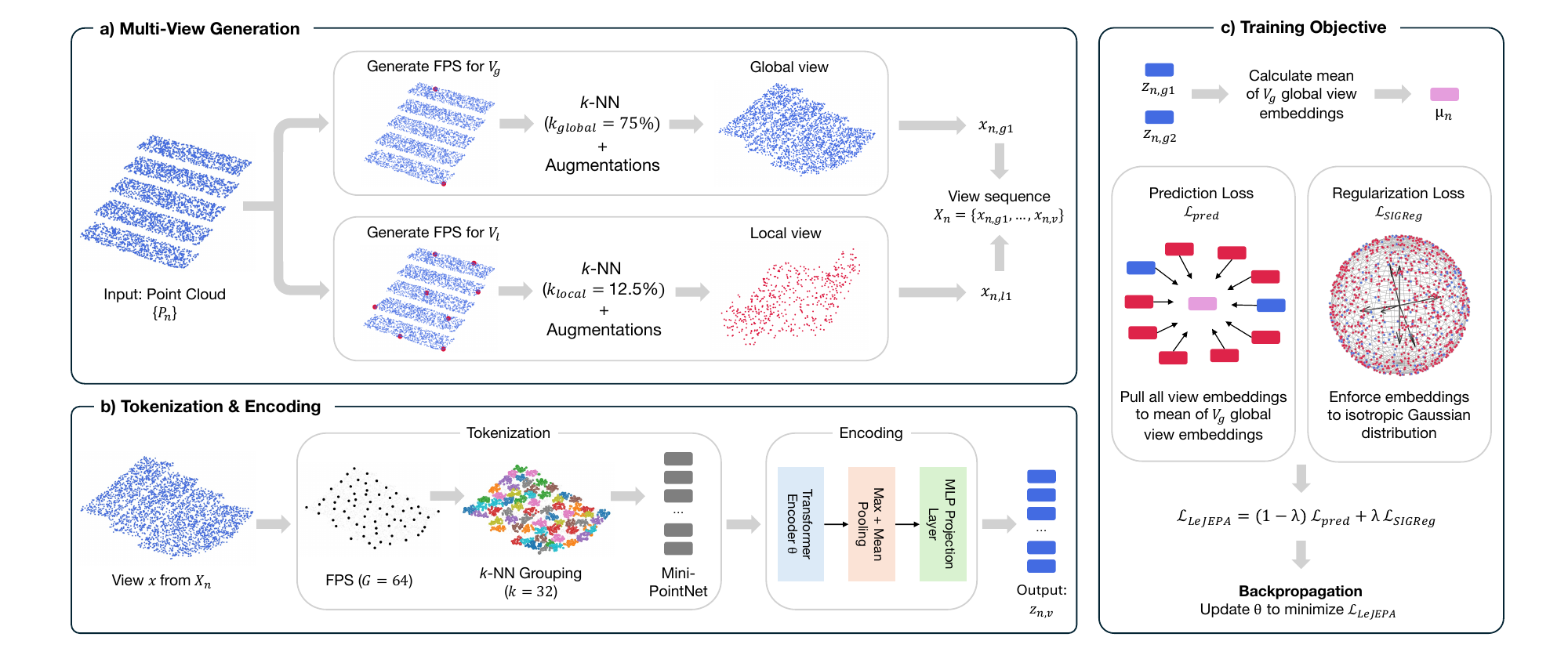
The proposed model adapts the Latent-Euclidean Joint Embedding Predictive Architecture (LeJEPA) to 3D BIM point clouds, learning geometric features by enforcing predictive consistency across multiple latent views of the same object. From a single BIM point cloud, a hierarchical multi-view generation stage produces 2 global views (i.e., 75% of the object, capturing overall topology) and 8 local views (i.e., 12.5%, capturing fine-grained detail) via Farthest Point Sampling and k-Nearest Neighbor cropping, followed by an augmentation pipeline that mimics real-world geometric noise. Each view is tokenized into 64 patch embeddings by a shared Mini-PointNet and encoded by a transformer backbone. The training objective then pulls every view embedding toward the mean of the global view embeddings, while Sketched Isotropic Gaussian Regularization (SIGReg) shapes the joint distribution of the embeddings into an isotropic Gaussian. This explicit regularization prevents representation collapse, removing the need for training heuristics such as stop-gradients or momentum-based teacher networks.