Jack Wei Lun Shi
I am a third year Ph.D. student in the Department of Civil and Environmental Engineering at the National University of Singapore, advised by Justin K.W. Yeoh and Wawan Solihin. My primary research focuses on spatial intelligence for BIM, exploring how geometric world models and joint-embedding approaches can train machines to reason about buildings in 3D space. Earlier on, I worked on leveraging and improving large language models and information retrieval techniques to automate code compliance for building regulations, with the goal of enhancing the design process in the architecture, engineering, and construction industry. I am also working with Kaichen Zhou on research relating to computer vision and world models.
If you're interested in my research or would like to collaborate, please don't hesitate to reach out via email.

Research
|
Honeycomb: Constant-size scene memory representation for video world models
, , , , , , , , arXiv, 2026 project page / paper / code Honeycomb is a video world model whose HexMemory stores the scene in six fixed-size feature planes, keeping long-horizon generation consistent when revisiting regions while memory stays constant in size. |
|
 |
Context-aware IFC element classification using geometric, semantic, and spatial graphs
, , , , , , Automation in Construction, 2027 Under review IFCContextNet classifies IFC elements by combining three separately encoded graphs: the element's geometry, its IFC semantic relations, and its surrounding spatial context. |
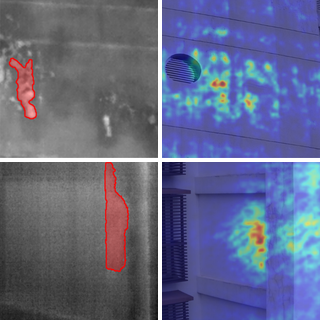 |
Automated concrete delamination detection via physics-guided SAM and unaligned cross-modal verification
, , , , , Automation in Construction, 2027 Under review A zero-shot framework that segments concrete delamination in drone thermal images with physics-guided SAM and filters false positives against unaligned visible imagery. |
|
Toward generalizable foundation models for 3D BIM geometry using a joint embedding predictive architecture
, , , , , , Automation in Construction, 2026 project page / paper / code A point cloud foundation model for 3D BIM geometry that generalizes across object classification, segmentation, and zero-shot tasks such as shape retrieval and anomaly detection. |
|
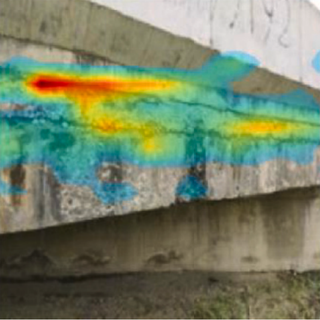 |
Visual question answering for bridge damage inspection using a multi-modal large language model
, , , , , Automation in Construction, 2026 paper BIVQA, built on a multi-modal large language model, answers natural-language questions about bridge inspection images while simultaneously localizing the damage. |
|
Self-supervised learning for BIM element classification using a joint embedding predictive architecture
, , , , , Automation in Construction, 2026 project page / paper / code By predicting the latent representations of masked regions of unlabeled BIM element point clouds, the pre-trained model outperforms supervised methods on element classification, especially when labeled data is scarce. |
|
 |
Reinforcement learning to improve large language model-based automated code compliance systems
, , , , arXiv, 2026 paper P4IR combines supervised fine-tuning with GRPO reinforcement learning to generate more accurate code skeletons from building regulations, outperforming leading frontier LLMs in a zero-shot setting. |
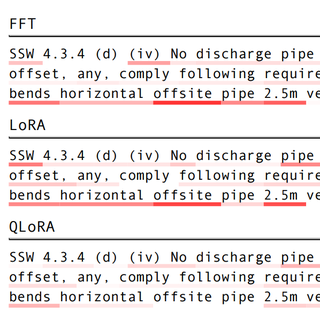 |
LLM attribution analysis across different fine-tuning strategies and model scales for automated code compliance
, , , International Conference on Computing in Civil and Building Engineering (ICCCBE), 2026 paper Perturbation-based attribution shows that full fine-tuning yields more focused attribution patterns over building regulation text than LoRA and QLoRA, and that larger LLMs learn to prioritize numerical constraints and rule identifiers. |
 |
Fine-tuning a large language model for automated code compliance of building regulations
, , Advanced Engineering Informatics, 2025 project page / paper BuildThemis combines a fine-tuned LLM with retrieval-augmented generation to turn building regulations into draft compliance-checking scripts that experts can readily refine. |
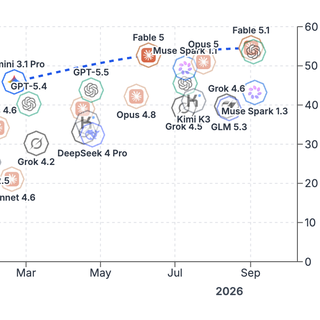 |
Humanity's last exam
, , , , ..., , ..., , Nature, 2026 project page / paper A benchmark of 2,500 expert-written questions at the frontier of human knowledge, on which state-of-the-art LLMs still score poorly. |
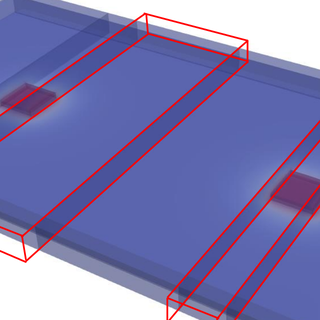 |
Component-based reduced order modeling for heat transfer in thermal fin and data server
, , International Workshop on Reduced Order Methods, 2023 (poster) poster Decomposing a thermal fin and a data server into reusable components yields reduced order models that match high-fidelity FEA results while running 26 and 6.5 times faster. |